

Brand Communication in 2026 - Matching Brand Voice to Customer Psychology in 2026
The Algorithm Made Me Do It: Why Brands Can't Stop Shouting
Social Media did something to us and our brands. It doesn't matter where you look - private lives, politics, business, everything has become so “loud” over the past decade. We all know the reason - the algorithmic bias of social platforms rewards high-energy "Excitement". Platforms prioritize content that drives engagement-likes, shares, comments, and rapid interactions. That creates selection pressure toward extroverted brand behavior regardless of whether your actual customers want or need it. As a result, brands optimize for platform algorithms rather than customer psychology.
They win the engagement game and lose the trust game.
Not everyone wants to be screamed at when deciding on which shampoo to use!
This article is about how to stop being the loudest voice in the room and start being the right voice for each segment listening.
Our thesis is that true brand resonance in 2026 requires a three-way alignment:
- Who they are (OCEAN personality traits)
- What they value (Schwartz values)
- How you show up (Aaker brand personality dimensions)
A landmark 2017 study by Matz, Kosinski, Nave, and Stillwell demonstrated that matching advertising content to personality traits significantly influences behavior. When ads were personality-matched, they resulted in up to 40% more clicks and 50% more purchases than mismatched or generic counterparts. Get this alignment right, and your brand doesn't just shout but connects. As you will learn in this article, the goal is to become an adaptive brand.
The volume vs. value conflict: Why frequency ≠ affinity
Let's start with the most widespread mistake in modern brand marketing: confusing engagement with affinity. Engagement is behavioral. It's clicks, opens, shares, and comments. It's measurable, trackable, and easily optimized. Platforms give you dashboards that show engagement rates climbing, and that feels like success.
Affinity is emotional. It's trust, loyalty, preference, and willingness to pay a premium. It's harder to measure and slower to build. And critically, high engagement does not guarantee high affinity. Actually, sometimes it actively undermines it.
A lovely quote describes it perfectly: "In a high-trust relationship, you can say the wrong thing, and people will still get your meaning. In a low-trust relationship, you can be very measured, even precise, and they'll still misinterpret you." - Stephen M.R. Covey
Driven by FOMO and their own social media use, companies are focusing on volume and noise rather than on the essence of their customer groups. They post 3x a day, email twice a week, and retarget aggressively. They show up everywhere, all the time, with maximum energy. The strategy is present through frequency.
Introverted and high-Conscientiousness customers prioritize value. They don't want to hear from you unless you have something genuinely useful to say. Every unnecessary touchpoint isn't neutral but a small withdrawal from the trust account.
The overstimulation threshold
There's a psychological concept worth understanding: the overstimulation threshold.
People high in Neuroticism and Introversion have a lower threshold for sensory marketing. Bright colors, fast cuts, loud audio, and high-energy messaging are not appealing to them. Conversely, this means that for a certain portion of your audience, your communication feels like a pain in the a**.
Just ignoring the fact is a bad idea, trust me! Depending on your category, 20-40% of your audience likely falls into segments where high-stimulation marketing actively drives them away.
This means that if your brand defaults to extroverted, high-energy communication because that's what performs well on Instagram, you're optimizing for the segment that responds to that style and systematically ignoring a significant portion of the audience.
Already in 1908, research from Yerkes & Dodson demonstrated that performance improved with increasing stimulation only up to a point. Beyond a threshold, further stimulation impaired learning, and that threshold shifted downward as task difficulty increased.
How to become an affinity brand - understand the “Who” and the “Why”
You might think now, "Oh, this sounds all good in theory, but impossible in real-world business.”
Disclaimer: It is possible and way easier than it was 10 years ago. Or to be honest, 10 years ago, it was basically impossible. Why it became so easy, I will explain further down, but first, let us look at the general approach. As mentioned before, we see the key to understanding
- Who are my customers (OCEAN personality traits)
- What do they value (Schwartz values)
- How you show up (Aaker brand personality dimensions)
Now, following, we will look at the different models to better understand this concept.
Framework OCEAN Personality - The Receiver’s Tuning
Before we talk about how your brand should sound, we need to understand how your customers hear. That is the beauty of it all - you won't be able to change your customer, but you can certainly change your brand communication and external perception. The easiest way to do so is to use the Big Five personality model (OCEAN). It describes five core dimensions of personality that are relatively stable across a person's lifetime:
- Openness to Experience: How much someone seeks novelty, complexity, and new ideas
- Conscientiousness: How organized, disciplined, and detail-oriented someone is
- Extraversion: How much someone seeks social stimulation and external energy
- Agreeableness: How cooperative, empathetic, and conflict-averse someone is
- Neuroticism: How emotionally reactive and sensitive to stress someone is
Each customer (segment) has 2-3 dominant traits that determine how they filter, interpret, and respond to messages, including brand messages.
How OCEAN traits sound in copies
Let us look at what personality-aligned communication actually looks like at the linguistic level. These aren't just stylistic choices but psychological alignment mechanisms. When your message matches how someone naturally processes information, it doesn't feel like marketing but understanding.
High Openness:
- Uses metaphors, abstract concepts, and "future-tense" language
- Asks open-ended questions ("What if...?" "Imagine...")
- Emphasizes novelty, creativity, and unconventional approaches
- Example: "Reimagine what's possible when you break free from traditional constraints."
High Conscientiousness:
- Uses concrete nouns, specific data, and logical connectors (if/then, because, therefore)
- Provides structure, steps, and clear sequencing
- Emphasizes reliability, accuracy, and proven methods
- Example: "Follow these 5 proven steps to achieve measurable results within 30 days."
High Extraversion:
- Uses energetic language, social proof, and communal framing ("we," "together")
- References groups, events, and shared experiences
- Emphasizes excitement, connection, and external activity
- Example: "Join thousands of people who are already transforming their lives together!"
High Agreeableness:
- Uses warm, inclusive, cooperative language
- Emphasizes harmony, support, and collective benefit
- Avoids confrontational or aggressive framing
- Example: "We're here to support you every step of the way."
High Neuroticism:
- Responds to loss-aversion framing and clarity-focused syntax (no ambiguity)
- Values reassurance, guarantees, and risk mitigation
- Reacts negatively to scarcity tactics or fear-based urgency
- Example: "Risk-free trial. Cancel anytime. We've got you covered."
Schwartz Values Framework- The "Why" Behind the Buy
Personality traits describe how someone behaves. Values describe what someone cares about. It is important to note that our personality traits are hardwired by the time we reach maturity, whereas values can change over time due to environmental, personal, or other circumstances.
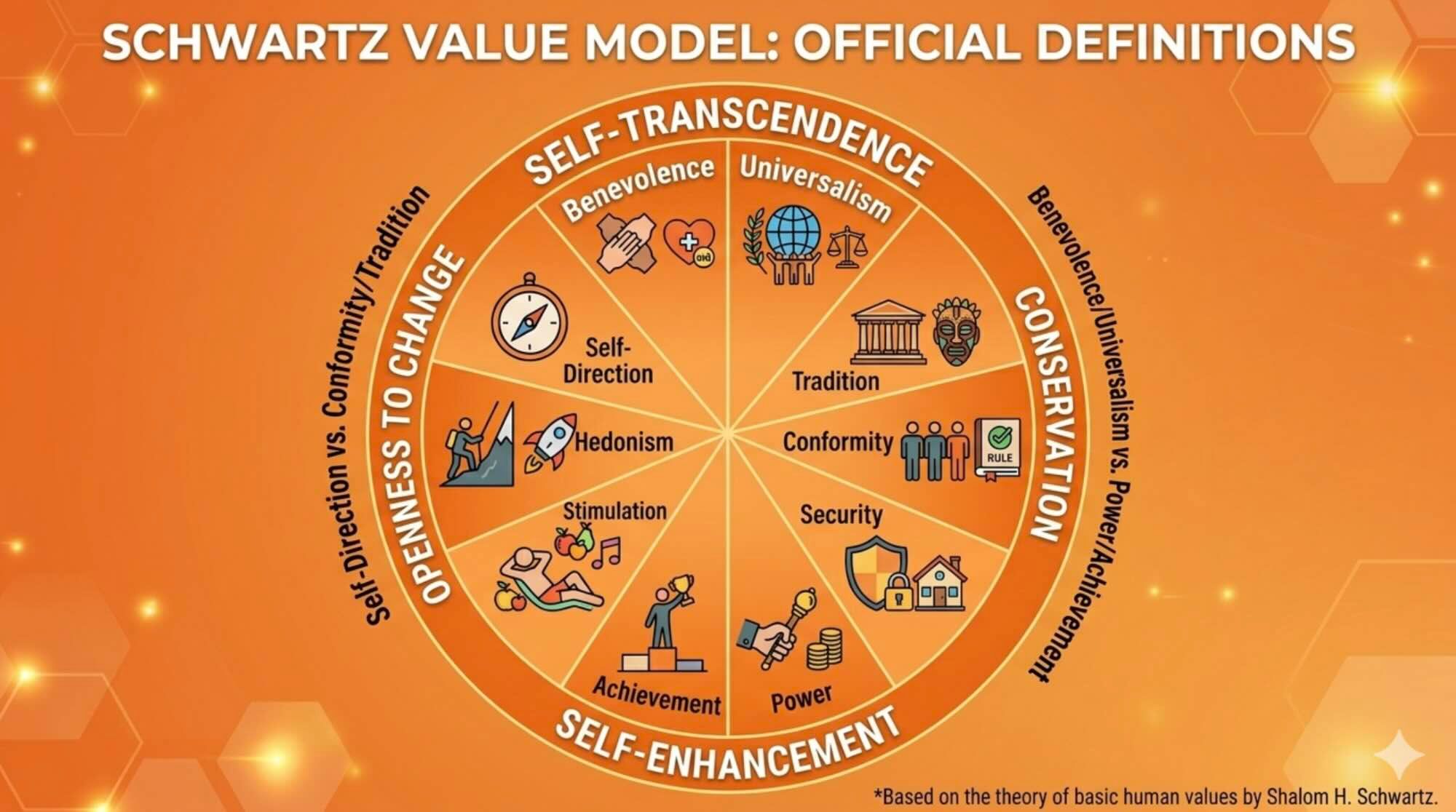
Shalom Schwartz's Theory of Basic Human Values identifies 10 universal motivations that guide behavior across cultures:
- Self-Direction: Autonomy, creativity, independence
- Stimulation: Novelty, excitement, challenge
- Hedonism: Pleasure, gratification, sensory enjoyment
- Achievement: Personal success, competence, ambition
- Power: Status, control, dominance over resources
- Security: Safety, stability, order
- Conformity: Restraint, rule-following, meeting expectations
- Tradition: Respect for customs, cultural norms, heritage
- Benevolence: Caring for close others, loyalty, helpfulness
- Universalism: Concern for all people and nature, justice, equality
Aaker’s brand personality framework - the transmitter
Now we get to your side of the equation: how your brand shows up.
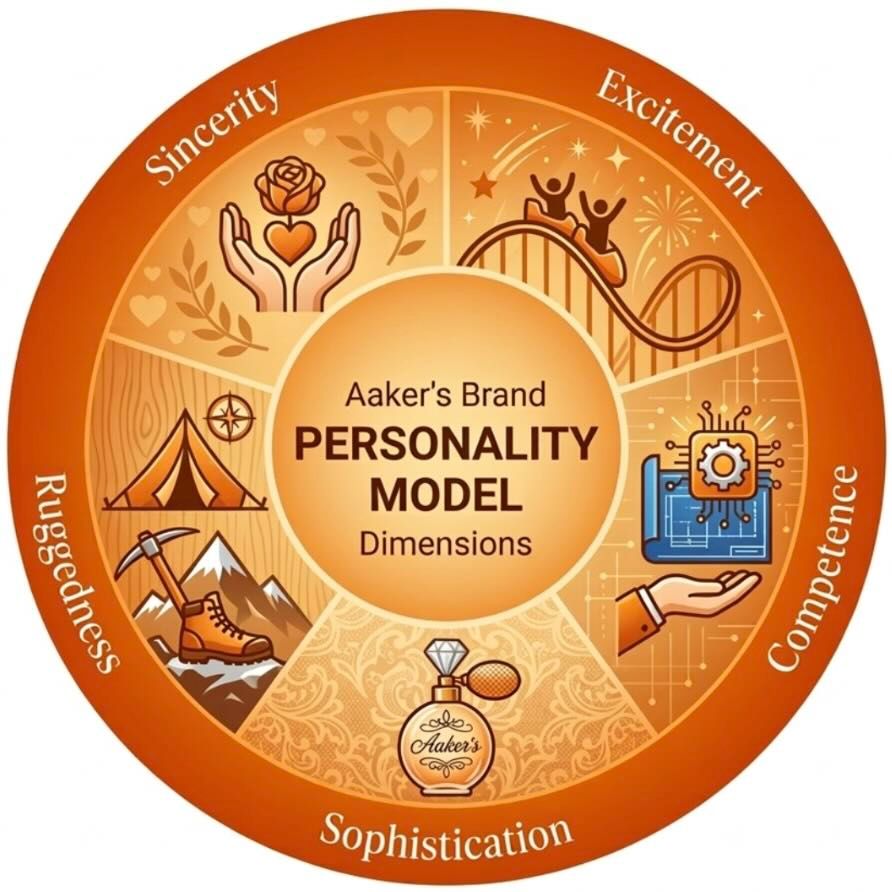
Jennifer Aaker's 1997 research identified five core dimensions of brand personality that parallel the Big Five human personality traits:
- Sincerity: Down-to-earth, honest, wholesome, cheerful. Brands perceived as authentic, transparent, and genuinely caring.
- Examples: Patagonia, Dove, TOMS
- Expression: Clear communication, ethical practices, community focus, accessible tone
- The Shadow Side: Sincerity can become boring. If taken too far, sincere brands risk being perceived as bland, unsophisticated, or lacking ambition.
- Excitement: Daring, spirited, imaginative, up-to-date. Brands that push boundaries and create energy.
- Examples: Red Bull, Tesla, Nike
- Expression: Bold visuals, unexpected messaging, sponsorship of extreme events, anti-establishment positioning
- The Shadow Side: Excitement can become unreliable. Brands that are always "cutting-edge" risk being perceived as unstable, impulsive, or lacking follow-through.
- Competence: Reliable, intelligent, successful, leader. Brands that demonstrate expertise and consistent performance.
- Examples: Microsoft, IBM, Mercedes-Benz
- Expression: Evidence-based messaging, technical specifications, industry leadership, professional tone
- The Shadow Side: Competence can become cold. Overemphasis on expertise and performance can make a brand feel impersonal, distant, or unapproachable.
- Sophistication: Upper-class, charming, glamorous, smooth. Brands that signal status and refinement.
- Examples: Louis Vuitton, Apple, American Express
- Expression: Minimalist design, premium materials, exclusivity, aspirational imagery
- The Shadow Side: Sophistication can become elitist. Brands that lean too heavily into exclusivity risk alienating broader audiences and being perceived as out of touch.
- Ruggedness: Outdoorsy, tough, strong, masculine. Brands built to last and perform under pressure.
- Examples: Jeep, Harley-Davidson, Timberland, Jack Daniel's
- Expression: Durable materials, outdoor settings, authenticity, resilience messaging
- The Shadow Side: Ruggedness can become aggressive. Overemphasis on toughness can make a brand feel exclusionary, confrontational, or insensitive.
Brand Personality isn’t binary
Most successful brands don't inhabit a single dimension. They combine a primary dimension with a secondary one to create distinction within their category and/or to better align with customers who already understand the importance.
Examples:
- American Express: Competence + Sophistication
- Capital One: Competence + Excitement
- Land Rover: Ruggedness + Sophistication
- Patagonia: Sincerity + Ruggedness
Brand/Customer Personality Alignment - Let us make it operational
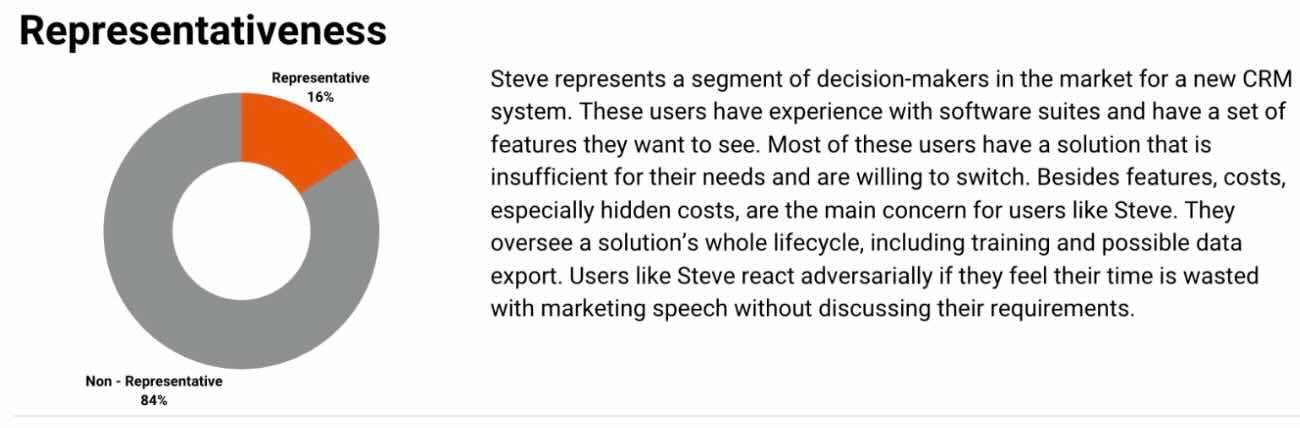
Once you understand the different personality tools, it is time to bring them together. If you analyze both brand and customer segments, you can measure their alignment. It is critical to first evaluate the segment sizes to set priorities. Of course, your brand personality should align with the largest customer clusters. Ideally, your persona profiles should include their size in relation to the entire customer base. This could look like this. From our experience, cluster sizes average 9% to 23%. So let us assume you create 5 personas representing your customer base, and the 2 biggest ones are 16% and 21% these are the ones you should be focusing on.
Next, you would map both the brand and the customer personality to see where you stand. This is an example of such a mapping.
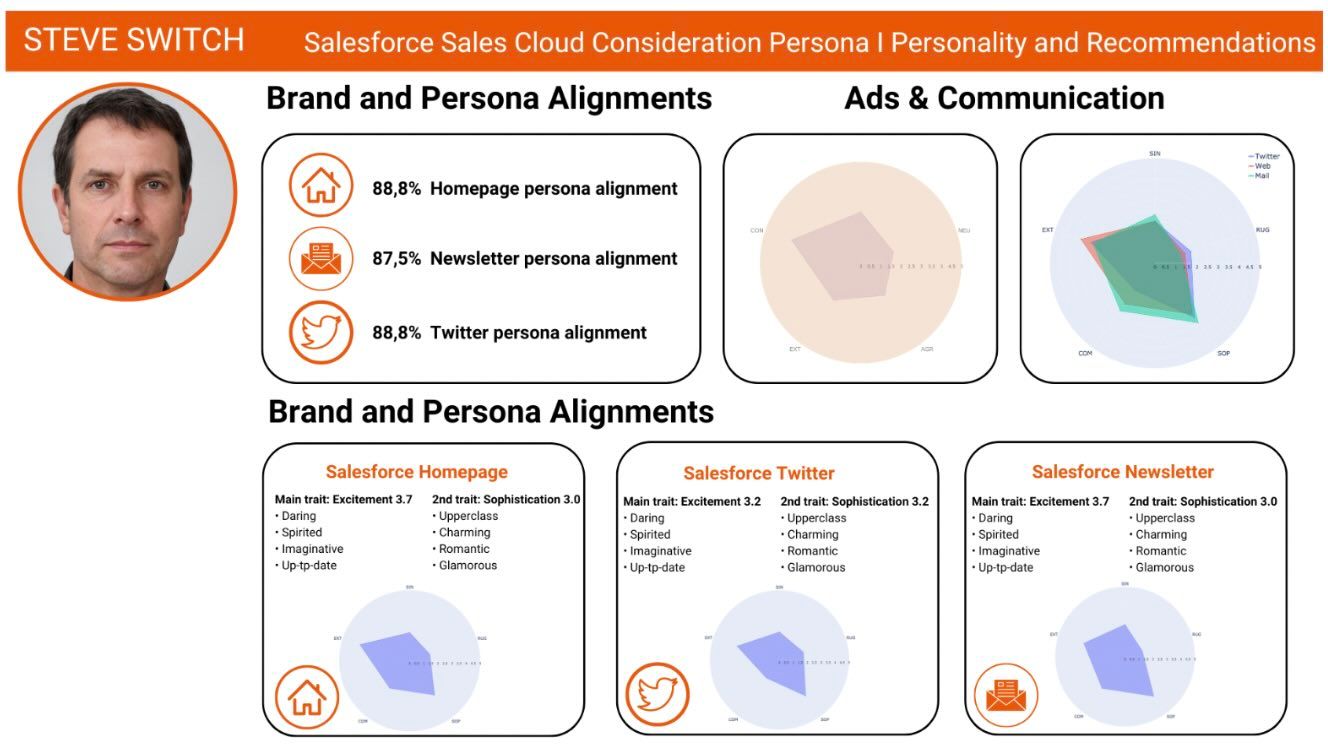
As you can see, there is an alignment of roughly 88% across channels, indicating good, consistent synchronization. If you are new to this, do not try to cover every channel at once; start with the most important channel for your customer base. With dynamic landing pages and personalized communication tools, you can easily adjust the tonality and visuals for different segments. For instance, when a segment exhibits high Openness and Self-Direction, the brand must pivot to an Excitement-Sincerity anchor. Instead of aggressive sales hooks, this requires a philosophical, "What if...?" tone delivered through channels like long-form thought leadership, transforming the brand from a simple vendor into an intellectual partner that validates the customer's drive for autonomy.
The following is a step-by-step approach to moving from theory to practice.
Step 1: Psychographic Audit
You no longer need customers to take personality tests. AI today can understand personality from how people write. Use it to analyze your existing customer data, reviews, support tickets, social media comments, and survey responses to map your customers' OCEAN traits and values. Important to note is that a company should NEVER do this at the individual customer level to not only align with GDPR and other data laws, but also to avoid being considered intrusive.
Step 2: Voice Modularization
Don't throw out your brand voice. Modularize it. Think of your brand as having:
- A Core DNA (your primary Aaker dimension-this doesn't change)
- Linguistic Adapters (OCEAN/Schwartz filters that adjust tone, complexity, and framing)
Example: Your brand is Competence-primary. That's the core. But:
- For high-Openness segments, add conceptual depth and "what if" framing
- For high-Neuroticism segments, add reassurance and risk mitigation
- For high-Agreeableness segments, add warmth and inclusive language
Thereby, the brand stays competent, and expression adapts.
Step 3: The Sandbox Test
Before rolling out personality-adapted communication to real customers, test it in a sandbox using digital customer twins.
Digital twins are AI-simulated representations of customer segments built from real behavioral data. You can run different messaging variants against these twins and measure predicted responses before committing budget. This is especially critical when moving away from a high-energy default. Leadership will be nervous that "toning it down" will hurt engagement. The sandbox lets you prove (or disprove) that fear with data before risking real customers.
Step 4: Measure what actually matters
Don't just track engagement. Track affinity indicators:
- Net Promoter Score changes by segment
- Customer Lifetime Value by communication style
- Churn rates for high-frequency vs. adaptive-frequency cohorts
- Qualitative feedback ("This feels like it's actually for me" vs. "Too many emails")
The goal isn't maximum engagement. It's the maximum value per interaction. One well-timed, personality-aligned message that drives a purchase is worth more than 47 generic blasts that generate opens but no action.
The agentic implementation - AI-powered voice adaptation at scale
In 2026, you don't write one brand voice anymore. You prompt a thousand variations of it. The question is how to use AI to style-transfer your core brand voice into OCEAN-specific variants without losing the brand's soul.
The architecture
- Core brand voice definition: Document your brand's Aaker dimensions, tone guidelines, and non-negotiable language (what you always say, what you never say).
- Personality adaptation layer: Create prompts that take core brand content and adapt it for specific OCEAN profiles: "Rewrite this email for a high-Conscientiousness, high-Security-value audience. Maintain our Competence brand dimension. Add structure, specific timelines, and risk mitigation. Remove any vague aspirational language."
- Validation layer: Use discriminative AI (not LLMs) to score whether the adapted content actually matches the target personality profile. LLMs are good at generating variations. They're not good at validating whether those variations are psychologically accurate.
- Human oversight: Personality-adapted content should be reviewed by humans who understand both the brand and the psychology. AI generates. Humans ensure it doesn't drift into parody or lose brand coherence.
Conclusion: The quiet revolution
The future belongs to the adaptive brands. In times driven by digital noise, the brand that knows when to be quiet and how to speak softly to the right person wins.
Be less bold. Be more precise.
Still, most brands broadcast at maximum volume to everyone, hoping to capture attention through sheer force of repetition. The adaptive brand speaks at the right volume, in the right tone, to the right person, at the right time, and earns attention through relevance. The transition from digital extrovert to adaptive brand isn't easy. It requires rethinking metrics, retraining teams, and resisting the algorithmic pressure to optimize for engagement over everything else.
But the reward is a brand that doesn't have to shout to be heard because when it speaks, people actually listen.
And in 2026, in a world drowning in noise, that's the only sustainable competitive advantage left.
