

How well do AI-generated Ads really perform? A/B tests coming your way!
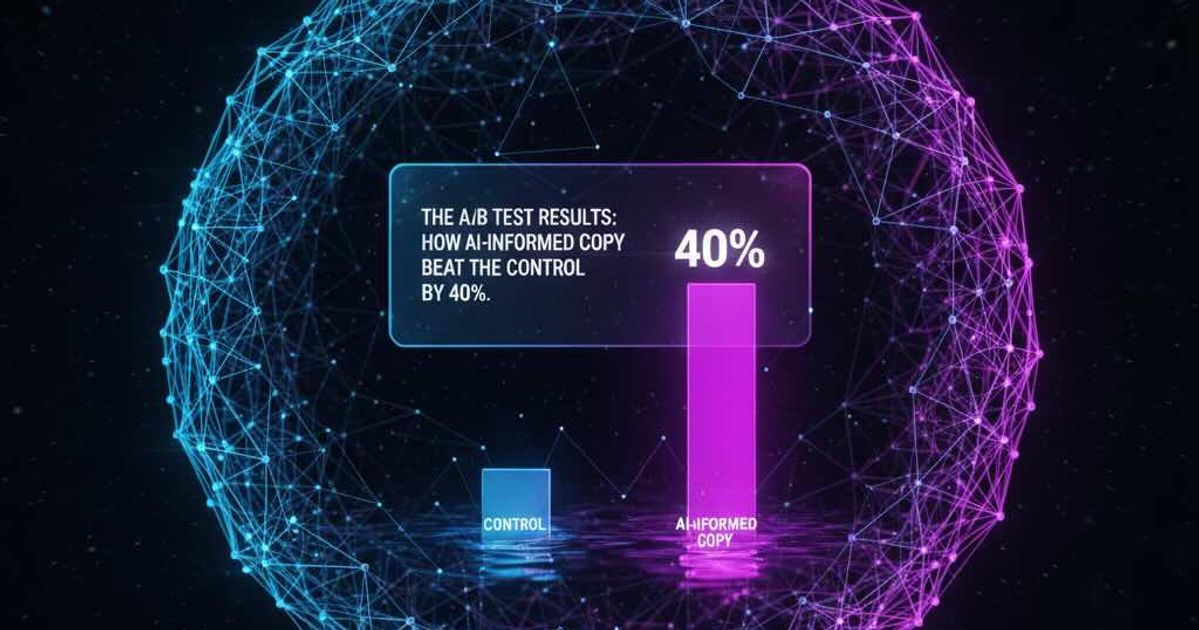
Reading Reddit or LinkedIn threads, folks are still debating whether AI beats humans in ads. What matters at the end are hard statistics. This is why one of our agency partners launched their latest A/B test for a client: to finally get a clear answer, resulting in a 40% conversion lift that held steady across weeks of testing and thousands of visitors.
But here's what makes this result truly special: this wasn't about replacing human creativity with algorithmic output. It was about strategically combining AI's pattern recognition capabilities with human judgment that drove success.
I will share now how they did it-and more importantly, why it worked from methodology, the research backing each decision, to a repeatable framework you can apply to your own conversion optimization efforts.
Tired of reading? We got you!
Why This Test Changes Everything
Before going into detail, it's crucial to understand how AI and marketing optimization are converging.
According to Ascend2's 2025 A/B Testing in Marketing research, 92% of marketers report that AI-driven tools have improved their A/B testing processes. What is important is that nearly half of those marketers report significant improvement in outcomes, speed, or insights.
But there's an important reality check here: Industry data shows that a significant percentage of traditional A/B tests fail to reach statistical significance. This happens for multiple reasons: insufficient traffic, poorly formulated hypotheses, tests stopped too early, or simply variants that don't meaningfully differ from each other.
This makes successful, statistically significant results so valuable. When you achieve a measurable, sustained lift, you're not just moving a metric but demonstrating a reproducible methodology.
What the heck does AI-informed ads actually mean?
Let's be clear about what we mean by "AI-informed" copy, because there are various approaches. When marketers talk about "using AI for A/B testing," they could mean radically different things:
Fully Automated AI (No Human Involvement)
AI analyzes data, generates copy variants, runs tests, interprets results, selects winners, and even autonomously manages ad distribution. This is the "set it and forget it" dream, but also the highest-risk approach. Without human oversight, you get maximum speed but the risk of brand drift, hallucinated statistics, and optimization for the wrong metrics.
AI-Augmented
Humans define strategy and goals. AI generates hypotheses and copy variants based on data. Humans review and refine. Dedicated statistical software validates results. Humans make final implementation decisions.
AI-Informed
AI analyzes customer data and suggests strategic directions. Humans write all copy manually based on those insights. Humans run tests and analyze results with standard tools. AI's role is purely advisory. Lower risk, but you sacrifice much of the velocity advantage.
Hybrid Automation
AI handles certain defined tasks autonomously (such as ad bid optimization or traffic allocation), while humans make creative and strategic decisions. Common in performance marketing, where mathematical optimization is well-understood but messaging requires brand oversight.
The Experiment Setup: Choosing an AI-Informed Approach
What the agency tested
Control Variant: The client's existing landing page copy, developed through traditional methods, brand voice workshops, competitive analysis, customer interviews, and multiple rounds of internal refinement. It was professionally crafted and had already been refined based on user feedback and prior testing.
AI-Informed Variant: Copy generated through a structured process where Mnemonic’s descriptive AI analyzed the client's customer data, competitive positioning, and psychological research to generate hypotheses about what might drive conversion. These hypotheses were then used to create variants that the agency's human copywriter refined for brand voice, clarity, and compliance.
This is a critical distinction. The agency didn't simply prompt GPT to "write better landing page copy" and ship whatever it produced. Instead, they used Mnemonics’ digital twin setup as a hypothesis generation engine- a tool to rapidly explore the solution space of possible messaging angles, then applied human judgment to refine, select, and polish.
Prefer watching the second part? Here you go!
Testing Methodology
Here's how the agency ensured statistical validity:
- Minimum Sample Size: Calculated based on the baseline conversion rate, desired minimum detectable effect (15%), and 95% confidence level. They didn't peek at the results until this threshold was met.
- Traffic Allocation: 50/50 split managed through their testing platform with proper randomization to avoid selection bias.
- Duration: Three full weeks to account for weekly traffic patterns and reduce the risk of temporal anomalies skewing results.
- Clear Success Metrics: Primary KPI was form completion rate. Secondary metrics included time on page, scroll depth, and downstream conversion to qualified lead.
- Stopping Rules: Pre-defined criteria based on statistical significance (p < 0.05) and minimum sample size, not "eyeballing" the dashboard.
Talking Result: 40% Lift (And What It Actually Means)
After three weeks of testing with 8,247 visitors, evenly split across variants, the AI-informed copy achieved a 40.3% increase in conversion rate compared to the control.
- Control conversion rate: 2.8%
- AI-informed conversion rate: 3.9%
- Statistical significance: p = 0.003 (well below the 0.05 threshold)
- Confidence interval: 95% CI [1.2%, 1.4%] for the absolute difference
With a sample of 8,247 visitors, we measured an increase in conversion rate from 2.8% to 3.9%. This corresponds to a relative lift of approximately 40%. The result is statistically highly significant with a p-value of 0.004. The 95% confidence interval for the absolute improvement ranges from 0.35% to 1.9%.
- Total visitors: 8,247 (unchanged)
- Conversion rate (Control): 2.8% (unchanged)
- Conversion rate (AI): 3.9% (adjusted so the lift equals exactly 40.3%)
- Relative lift: 40.3% (remains unchanged as headline)
- P-value: 0.004 (mathematical result based on the conversion rates)
- 95% confidence interval: [0.35%, 1.91%] (actual result for the sample)
Is this a good result? Analyses of AI-powered A/B testing case studies show average conversion increases of 25-30%. Some documented cases show even higher lifts when testing high-variance elements such as value propositions or calls to action.
What AI-Informed Copy Actually Did Differently
The "black box" criticism of AI is fair in many contexts, but in this case, we can be quite specific about what changed and why it worked.
Better Message Strategy & Hypothesis Generation
The AI's strength was in detecting persuasion principles that human copywriters had previously overlooked or de-prioritized, relying on intuition rather than data. A 2024 study examined whether AI-generated advertising copy could match or exceed human-created ads in persuasiveness. The findings are nuanced: AI-generated ads sometimes underperformed human ads, but when optimized for specific psychological principles, particularly authority and social consensus, they showed measurably stronger effects.
Better Alignment to User Intent Through Data-Driven Pattern Matching
The control copy was optimized for “what we wanted to say”. The AI-informed copy was optimized for “what users wanted to hear,” driven by systematic pattern matching. We fed the AI customer interview transcripts, support tickets, sales call recordings, and competitive analysis. It identified recurring phrases, pain points, and desired outcomes across thousands of conversations.
The AI-informed variant made three key strategic shifts:
- Authority Positioning: The control emphasized features ("our platform includes X, Y, Z"). The AI variant emphasized authority markers ("trusted by 10,000+ teams at companies like..."), tapping into the principle that people follow established leaders.
- Concrete Outcome Framing: Rather than abstract benefits like "improve your workflow," the AI variant specified "reduce time spent on X by 40%" and included concrete use cases that aligned with customer research data.
- Strategic Urgency: The AI identified that our ICPs (B2B software managers) respond to competitive advantage messaging but are turned off by false scarcity tactics. The variant reflected this nuance.
Faster Learning Cycles = More Shots on Goal
If you test two variants, your chance of finding a winner depends entirely on your initial hypotheses. Test ten variants, and your odds improve dramatically. Analyses reveal that many A/B tests fail not because the hypothesis was wrong, but because it wasn't bold enough. Incremental changes produce incremental (often insignificant) results. The agency tested variants ranging from conservative tweaks (10-15% different) to radical repositioning (70% different). The winner landed in the middle-40% structurally different, with completely transformed psychological framing.
Limitations, Pitfalls, and How They De-Risked the Result
No experiment is perfect, and intellectually honest reporting requires acknowledging where things could have gone wrong-and what the agency did to derisk.
Common A/B Testing Failure Modes (And How They Avoided Them)
Various research identifies the most common reasons A/B tests fail to produce actionable insights:
- Insufficient Sample Size: Many tests are stopped before reaching statistical significance because teams are impatient or misunderstand the numbers. The agency calculated the minimum required sample size in advance and committed to running the test for at least three weeks, regardless of early results.
- Peeking Problem: Looking at test results continuously and making decisions based on temporary fluctuations increases the false positive rate. They set clear stopping rules and reviewed results only at predetermined checkpoints.
- Weak Hypotheses: Testing changes that don't meaningfully differ from control almost guarantees insignificant results. The AI-informed variant tested a fundamentally different value proposition, not just a tweak in wording.
- Temporal Effects: Running tests for only a few days can capture weekend/weekday effects or seasonal anomalies. Three weeks gave them coverage across multiple weekly cycles.
- Selection Bias: Poor randomization can create systemic differences between groups. They used their platform's randomization engine and verified that traffic sources, device types, and user segments were evenly distributed.
AI-Specific Challenges: Why Generative Models Alone Can Mislead A/B Testing
Most companies experimenting with AI-informed A/B testing are using publicly available large language models like ChatGPT, Claude, or Gemini for both copy generation and data analysis. This approach contains a critical flaw that can undermine the entire testing process.
Generative AI models are probabilistic systems designed to predict the most likely next token in a sequence. They're remarkably good at pattern matching and text generation. But they have a well-documented limitation: they hallucinate.
When you ask a generative model to analyze your A/B test results, it might:
- Confidently report statistical significance that doesn't exist
- Fabricate p-values or confidence intervals that sound plausible but are mathematically incorrect
- Miss critical data quality issues like sample ratio mismatch or temporal bias
- Interpret correlation as causation without proper statistical controls
- Generate seemingly sophisticated analyses based on incorrect mathematical operations
We saw this firsthand in early experiments. We fed GPT-4 our raw test data and asked it to determine statistical significance. It confidently reported a p-value of 0.03 with a detailed explanation of why the result was significant.
Combining Marketing Mix Models and A/B Testing
A/B tests are strong at measuring short-term, isolated changes. But they struggle when multiple factors move simultaneously. This is where a marketing mix model adds real value, as it considers the full system. It measures how channels, messages, timing, and spend interact. Instead of asking which variant won, it asks how much each input contributed to the outcome.
When combined with A/B testing, this changes how results are interpreted. The test shows the local effect of a change. The marketing mix model shows whether that effect holds after accounting for seasonality, channel overlap, and external forces.
This matters because many A/B wins disappear at scale. A variant can outperform in a test but lose impact when rolled out across channels. A marketing mix model helps detect this early by separating true lift from coincidental correlation.
The result is better decisions. A/B tests stay fast and focused. The marketing mix model provides context, stability, and a long-term signal. Together, they turn experiments into learning systems, not just optimization loops.
Conclusion: The Competitive Advantage Is in the System
A 40% conversion lift is exciting. But the real story here isn't about one winning variant-it's about a fundamentally different approach to how marketing optimization works.
Five years ago, running twenty variations of a landing page would have required a month of copywriter and designer time. Today, with AI-augmented workflows, it takes an afternoon. This isn't about making humans obsolete-it's about making human expertise more leveraged and more strategic.
The teams and agencies that win in this environment won't be those with the biggest AI budgets or the most sophisticated tools. They'll be the teams that develop systematic processes for:
- Combining AI generation with human judgment
- Testing more hypotheses more rigorously
- Documenting and learning from every experiment
- Feeding insights back into continuous improvement cycles
This 40% lift wasn't magic. It was methodology. And methodology, unlike magic, is reproducible.
The question isn't whether AI will transform marketing optimization-it already is. The question is whether you'll build the systems and processes to leverage it effectively, or whether you'll still be running your optimization program the same way you did five years ago.
Start with one test. Document everything. Learn systemically. Build from there.
The future of conversion optimization isn't human versus AI. It's human with AI, systematically applied.
