

Modern Buyer Intelligence Starts With Why, Not Who.

Modern Buyer Intelligence Starts With Why, Not Who.
For decades, buyer intelligence meant knowing surface-level facts: your customer was a 35-year-old male in Chicago. This demographic snapshot drove media buys, shaped product messaging, and informed market forecasts across industries.
In 2026, that approach no longer works. The evidence is mounting that we're experiencing a fundamental shift in how we understand consumers.
The reason is simple: The current market is far more complex than demographics can capture. Two consumers can share identical age, income, and zip code while holding completely different beliefs, motivations, and decision-making frameworks. A 35-year-old in Chicago who prioritizes sustainability thinks and buys differently from another 35-year-old in the same city who values convenience above all else.
And surely you have seen the persona comparison between Charles and Ozzy Osbourne - it never gets old and really displays how useless demographics are.
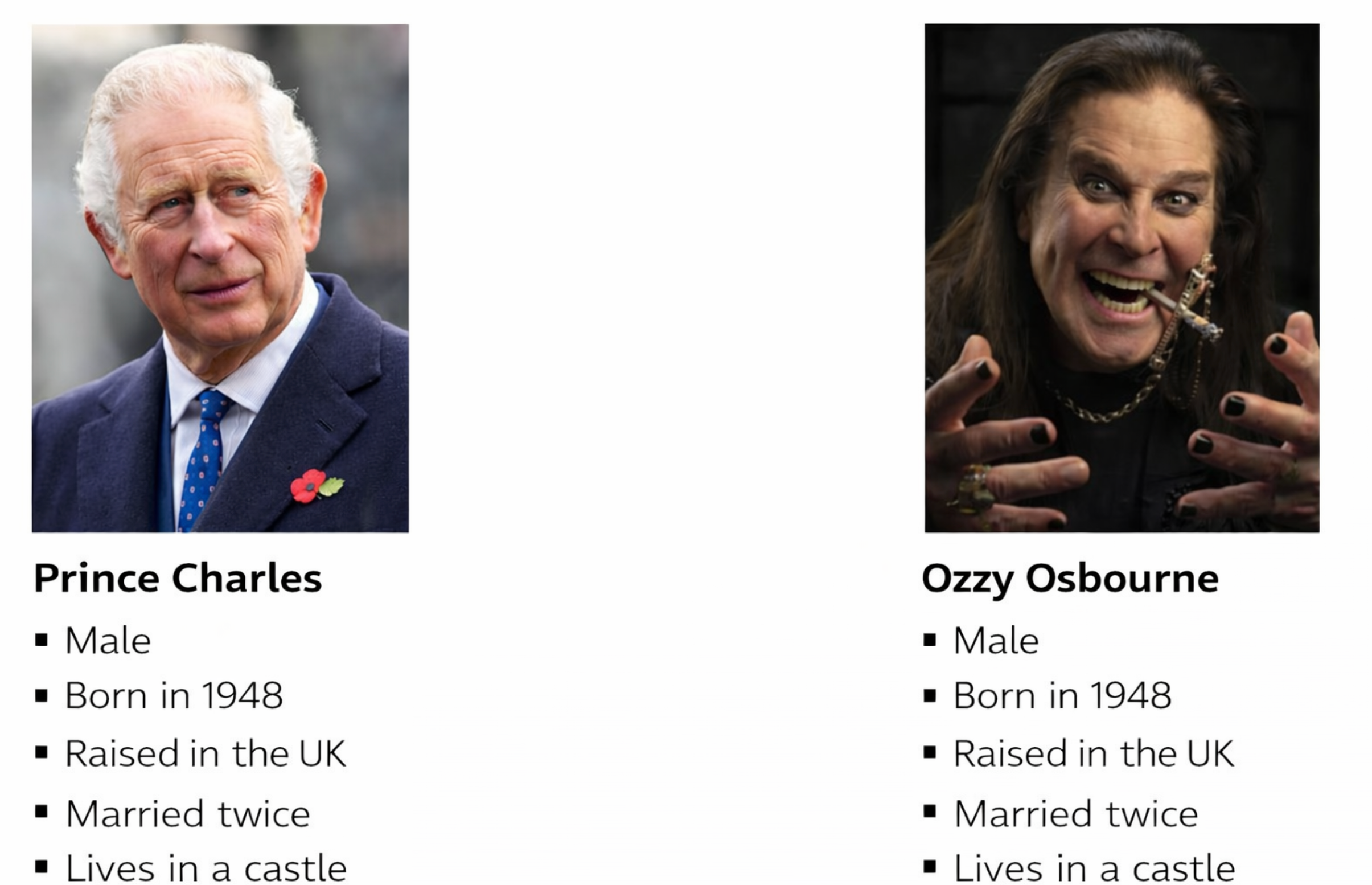
To reach today's consumers, you don't need to know where they live. You need to know how they think. Demographics tell you who someone is on paper. Psychographics reveal why they buy, what they value, and how they make decisions. That's the intelligence that drives results now.
What Is Psychographic Segmentation?
Psychographic segmentation divides audiences based on the psychological characteristics that drive behavior and choice-the internal forces that explain not just what people buy, but why they buy it.
This includes:
- Personality Traits: The core psychological characteristics that shape how they interact with the world. Are they introverted or extroverted? Risk-takers or cautious planners? Spontaneous or highly organized? Analytical or intuitive? These traits influence everything from brand preferences to purchasing behavior. In addition research shows that our personality highly effects other factors such as activities or interests. You could assume that the majority of people that are risk-avere tend not to choose hobbies like bungee jumping.
- Values: The deep, non-negotiable principles that guide major decisions-things like family, freedom, achievement, security, or environmental responsibility.
- Activities & Interests: How people spend their time, what hobbies they pursue, and what genuinely excites them-whether that's rock climbing, gaming, cooking, or restoring vintage cars.
- Opinions & Beliefs: Their views on social issues, cultural movements, political topics, and life priorities. Do they believe in radical transparency or strategic privacy? Community over individualism, or vice versa?
- Lifestyle: The broader patterns of how they live and see themselves. Are they minimalists or maximalists? Urban explorers or suburban settlers? Digital nomads or rooted traditionalists?
Prefer watching, we got you!
Unlike demographics, which tell you who someone is on paper, psychographics reveals why they make the choices they do. It's the difference between knowing someone is 35 and knowing they're a 35-year-old optimist who values sustainability, craves novelty, and makes decisions based on peer recommendations rather than expert reviews.
Why Psychographics Matters - With Supporting Evidence
Superior Predictive Power
Psychographics predicts behavior more accurately than demographics alone. The Journal of Marketing Research found out that psychographic segmentation improved prediction of consumer choices by up to 30% compared to demographic models. A study in Psychology & Marketing demonstrated that values and lifestyle factors were stronger predictors of purchase intent than age or income for multiple product categories.
This makes sense: psychographics taps into internal motivations, values, and belief systems-the psychological drivers that actually explain why someone chooses one brand over another. Demographics tell you a customer could buy; psychographics tells you they will.
Deeper Emotional Connection and Brand Loyalty
According to Harvard Business Review, emotionally connected customers have a 306% higher lifetime value and are more than twice as likely to recommend a brand. Psychographic targeting enables this connection by aligning messaging with what customers genuinely care about at a psychological level.
A 2023 study in the Journal of Consumer Psychology found that marketing campaigns aligned with consumers' core values generated significantly higher engagement rates and brand affinity than generic demographic targeting. When brands reflect customers' identities and beliefs, they earn loyalty-not just attention.
Higher Conversion Rates and ROI
Psychographic segmentation delivers measurable business results. McKinsey research shows that companies using advanced segmentation strategies (including psychographics) see 10-15% revenue increases and up to 20% improvements in marketing ROI.
A Forbes analysis of e-commerce data revealed that psychographically targeted campaigns achieved conversion rates 2-3 times higher than demographic-only approaches. The reason: messages that speak to how people think and what they value drive action more effectively than messages that only acknowledge where they live or how old they are.
Personalization That Actually Resonates
In an time where 71% of consumers expect personalization (according to McKinsey), surface-level segments no longer suffice. Epsilon found that 80% of consumers are more likely to purchase when brands offer personalized experiences-but only when that personalization feels authentic and relevant.
Psychographics enables this deeper personalization by informing not just what you offer but how you communicate it. Two customers with identical demographics may respond to completely different tones, values, and messaging approaches based on their psychological profiles.
Essential for Navigating Market Fragmentation
Traditional mass-market segments are fracturing. A Pew Research study documented increasing polarization in consumer values and worldviews even within demographic cohorts. Two 40-year-old suburban parents may share nearly nothing in terms of media consumption, brand preferences, or decision-making processes.
Deloitte confirms that psychographic factors-particularly values and lifestyle orientation-now vary more within demographic groups than between them. Brands that rely solely on demographic targeting are essentially marketing blind.
Complements Demographics for Complete Intelligence
Demographics tell you who someone is; psychographics tells you why they make choices. According to the Journal of Business Research, combining both approaches creates segmentation models with 40-50% better predictive accuracy than either method alone.
The most sophisticated brands use demographics to identify addressable audiences, then deploy psychographics to understand motivations, craft resonant messaging, and predict behavior. It's the difference between reaching people and actually moving them.
Traditional Psychographic Models - AIO and VALS
Before exploring modern frameworks, it's important to understand the two foundational psychographic models-and recognize their limitations.
AIO (Activities, Interests, Opinions)
Developed in the 1970s, AIO segments consumers based on what they do (activities like travel or sports), what they care about (interests such as fashion or technology), and what they think (opinions on social issues or lifestyle choices).
AIO was a major advancement, helping brands move beyond demographics to understand lifestyle patterns. The Journal of Marketing Research showed it could identify meaningful consumer segments that age and income couldn't reveal.
The problem: AIO relies on self-reported survey data about behaviors that change over time. A study in Psychology & Marketing noted that AIO captures surface-level activities rather than the stable internal drivers that shape lasting motivations. Your hobbies may evolve, but your core personality traits remain consistent.
VALS (Values and Lifestyles)
Developed by Stanford Research Institute in 1978 and updated in 1989, VALS segments consumers into eight groups-Innovators, Thinkers, Achievers, Experiencers, Believers, Strivers, Makers, and Survivors-based on psychological motivations (ideals, achievement, or self-expression) and resources like income and education.
According to the Journal of Consumer Research, VALS was revolutionary for introducing psychological depth into segmentation and has been used by major brands for decades.
But VALS has constraints. An analysis in the International Journal of Market Research shows that it groups people into broad motivational categories rather than measuring individual psychological traits. Two "Achievers" may share goals but have vastly different personality profiles, risk tolerances, and emotional triggers.
The Gap in Traditional Models
Both AIO and VALS were pioneering. Research from the Marketing Science Institute confirms they established that psychology matters more than demographics for predicting behavior.
Yet neither captures the stable internal traits-like the Big Five personality dimensions (openness, conscientiousness, extraversion, agreeableness, neuroticism)-that modern behavioral science shows are the most reliable predictors of consumer behavior.
A 2022 meta-analysis in Consumer Psychology Review found that personality-based psychographic models outperformed traditional frameworks like VALS by 25-40% in predicting actual purchases. The reason: personality traits remain stable throughout adulthood, while stated interests and motivational categories can shift.
Today's most sophisticated psychographic approaches integrate personality psychology, behavioral economics, and neuroscience-measuring not just what people say they care about, but the deep psychological traits that govern how they make decisions, respond to messaging, and form brand attachments.
Why OCEAN (The Big Five) Is the Gold Standard for Psychographic Segmentation
If AIO and VALS capture snapshots of what people are doing right now, OCEAN describes the enduring patterns in how they think, feel, and respond across situations-grounded in decades of rigorous personality research.
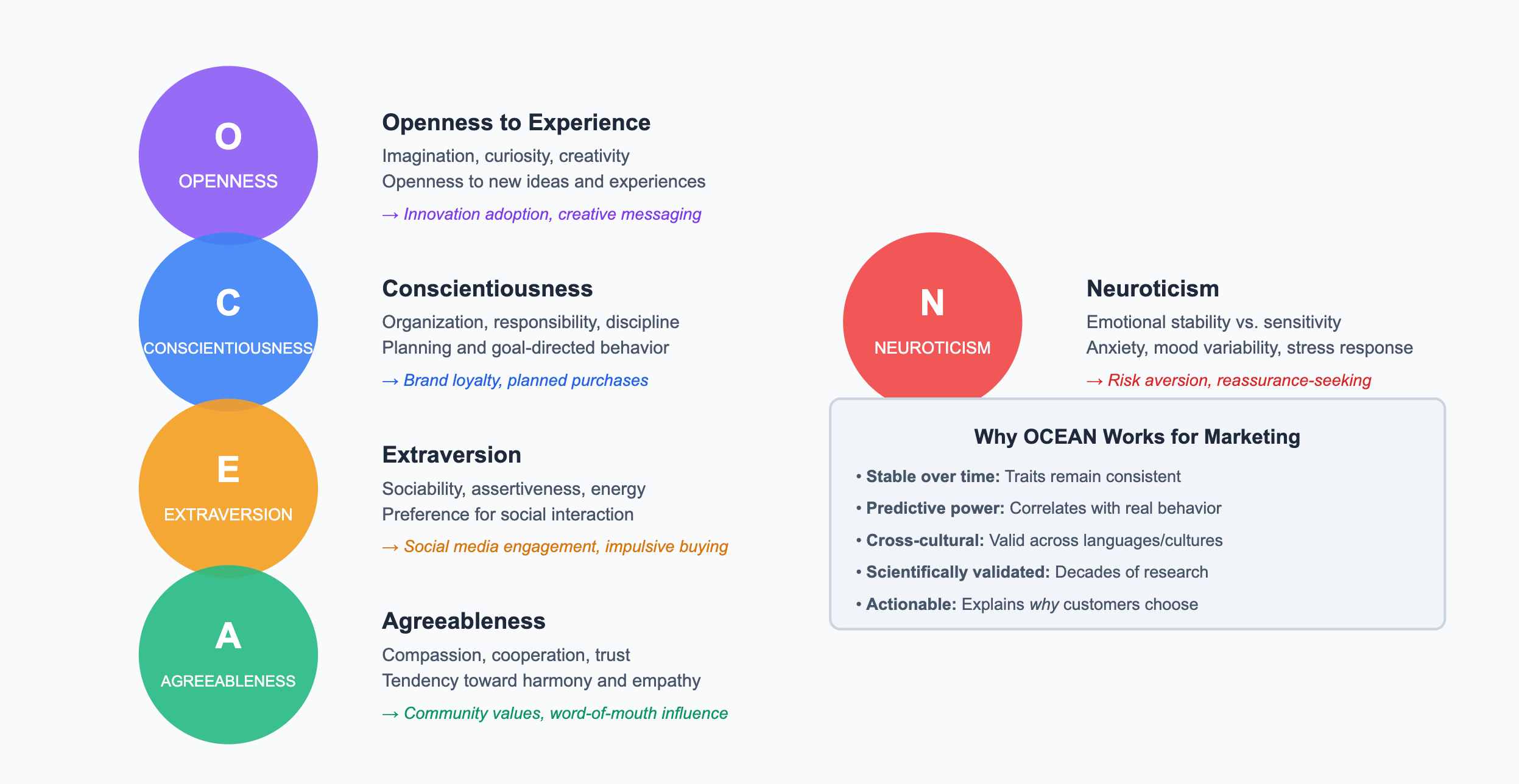
The Big Five traits-Openness, Conscientiousness, Extraversion, Agreeableness, and Neuroticism-represent the dominant model of personality in contemporary psychology, supported by extensive empirical validation across thousands of studies.
Stability Over Time
Longitudinal research published in the Journal of Personality and Social Psychology shows that Big Five scores remain remarkably consistent throughout adulthood, with only gradual age-related shifts. This makes them far more reliable predictors than interests or lifestyle labels that can change within months.
Deep Roots, Not Surface Signals
Meta-analyses in Psychological Bulletin demonstrate that these traits show moderate heritability and links to neurobiological factors. They capture fundamental psychological tendencies rather than temporary behaviors, opinions, or fads. You're measuring who someone is, not just what they're currently into.
Cross-Cultural Validity
Factor-analytic research published in the Journal of Cross-Cultural Psychology has replicated the Big Five structure across dozens of languages and cultures. This universal applicability makes OCEAN an ideal backbone for international segmentation systems-something AIO and VALS struggle to provide.
Proven Predictive Power
The Journal of Research in Personality confirms that Big Five traits correlate with meaningful life outcomes including job performance, health behaviors, relationship quality, financial decisions, and overall well-being. These aren't abstract labels-they predict real-world behavior.
- In marketing contexts specifically, studies in Journal of Consumer Psychology have linked:
- Conscientiousness to brand loyalty, planning behavior, and price sensitivity
- Extraversion to social media engagement, impulsive purchases, and receptiveness to exciting messaging
- Neuroticism to risk aversion, preference for reassurance-focused copy, and sensitivity to negative reviews
- Openness to willingness to try new products and receptiveness to creative advertising
- Agreeableness to word-of-mouth influence and community-oriented brand values
A 2023 study in Marketing Science found that campaigns tailored to Big Five profiles achieved 35% higher engagement than demographic targeting and 28% higher than VALS-based segmentation.
The Strategic Advantage
Unlike "who likes what" frameworks, OCEAN segments on why people consistently choose, avoid, or delay-providing a stable foundation for anticipating how audiences will think and act as markets evolve.
The Journal of Business Research shows that OCEAN works best not as a replacement for behavioral or demographic data, but as the psychological backbone that explains why patterns emerge within other segments. It reveals the enduring decision-making styles underneath each customer cluster, making every other segmentation approach more predictive and actionable.
The Schwartz Value Model: Segmenting by What People Care About Most
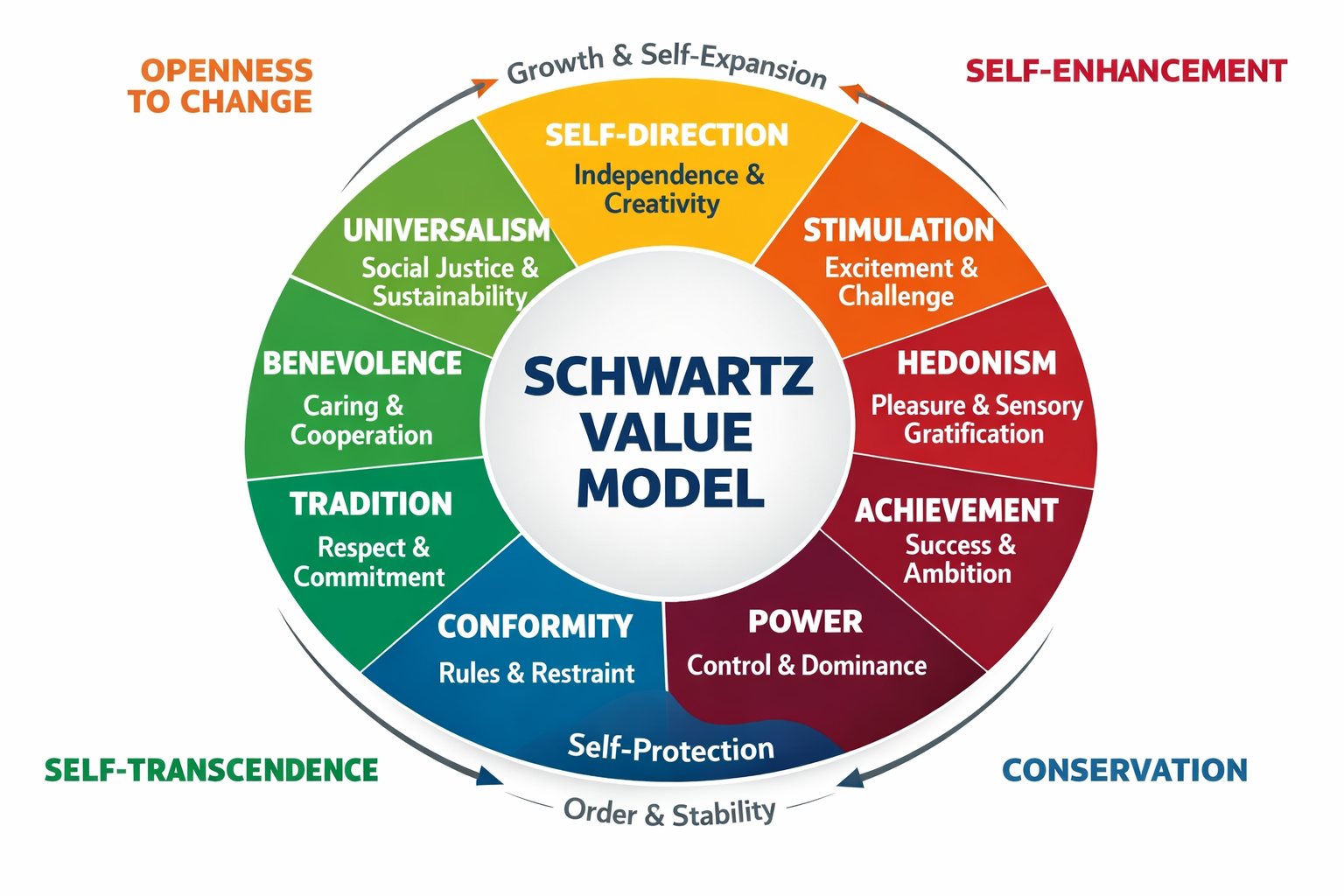
The Schwartz Value Model segments audiences by deep motivations rather than surface preferences, making it a powerful complement to personality-based frameworks like OCEAN.
What It Is?
Developed by psychologist Shalom Schwartz and published in Advances in Experimental Social Psychology, the Theory of Basic Human Values identifies ten universal motivational values that guide behavior across cultures:
- Self-Direction: Independence, creativity, freedom
- Stimulation: Excitement, novelty, challenge
- Hedonism: Pleasure and gratification
- Achievement: Personal success and competence
- Power: Social status and control
- Security: Safety, harmony, stability
- Conformity: Restraint and respect for norms
- Tradition: Cultural and religious customs
- Benevolence: Caring for close others
- Universalism: Social justice and environmental protection
Research across 82 countries, documented in Online Readings in Psychology and Culture, validates this structure internationally.
Why Value-Based Segmentation Works
Research in the Journal of Cross-Cultural Psychology shows that values are enduring priorities influencing long-term choices across career, politics, and consumption. A study in Social Psychological and Personality Science found core values remain stable across decades.
While the same value structure appears across cultures, Schwartz's research demonstrates that individuals rank these values differently, creating meaningful segmentation opportunities. A 2023 Marketing Science study found that value-matched advertising achieved 42% higher click-through rates than demographic targeting.
Combining Personality Traits and Values for Superior Prediction
Values and personality work best together when personality explains how people tend to respond and values explain what they're aiming for over time.
How Values Complement OCEAN
Studies combining both frameworks show substantial improvements in predictive power. A facet-level analysis in Personality and Individual Differences found that regression models predicting Schwartz's ten basic values from personality revealed multiple correlations of .53 for HEXACO facets, with particularly large correlations exceeding .60 for power, universalism, and cooperation values.
Why Combining Them Increases Predictive Power
Research in Current Psychology confirms that personality traits and personal values were comparable as predictors of a wide range of everyday behaviors. However, each provides unique information: trait-only models explain behavioral consistency but can miss motivational priorities.
A meta-analysis in Personality and Social Psychology Bulletin found that values predicted cognitively based outcomes better than traits, while traits predicted affectively based outcomes better than values. This suggests they capture complementary aspects of human psychology.
Same Trait, Different Value: A Practical Example
Two highly conscientious consumers may both plan ahead and follow through, but their choices diverge sharply based on values. Research shows that Conscientiousness correlated most positively with Security, Conformity and Achievement values. A conscientious person prioritizing Achievement values will favor prestige and performance brands, while one high in Benevolence will choose brands associated with fairness and prosocial impact.
Best Practices: Layering Traits, Values, and Behavior
- Use OCEAN traits to anticipate response style: preference for novelty versus familiarity, need for order, sensitivity to threat, and sociability
- Add Schwartz values to identify primary motivations: status, security, autonomy, stimulation, tradition, or universalism-clarifying what "success" means for each segment
- Ground both in behavioral data (purchases, engagement, channel use) to confirm how stable dispositions translate into real-world actions
AI Makes Psychographic Segmentation Faster, Cheaper, and Scalable
AI and natural language processing (NLP) are transforming the way psychographics are inferred and applied. Instead of relying solely on surveys and manual coding, modern models can extract personality traits, values, and motivations directly from language data at scale. This shifts psychographic profiling from slow and expensive to automated and dynamic.
How AI Infers Personality and Values
Text-based models extract traits from language. AI systems analyze linguistic features-such as word choice, syntax, topics, and stylistic markers-to predict Big Five (OCEAN) personality traits from social media posts, blogs, reviews, and other text data. These methods correlate linguistic patterns with established psychological constructs.
Advanced NLP maps free text to psychological constructs.
Transformer models and other modern architectures can align unstructured text with validated constructs like personality traits and human values. In some research settings, NLP-derived assessments approach the accuracy of traditional questionnaires.
Dedicated classifiers detect value dimensions.
Some tools are specifically trained to recognize value frameworks like Schwartz's value dimensions (e.g., security, power, universalism) from short text inputs using labeled datasets and machine learning classifiers.
Why AI Improves Psychographic Work
Automated text analytics replace manual coding. Traditional psychographic analysis often relies on human raters interpreting open-ended responses, which can introduce bias and inconsistency. AI removes much of that subjectivity by standardizing how language is processed and interpreted.
Speed and cost-efficiency at scale
Once trained, AI models can process millions of documents quickly with very low marginal cost, turning streams of reviews, comments, chats, and posts into continuously updated psychographic profiles.
Near real-time adaptability
AI systems can ingest fresh text continuously, allowing segments and personality scores to update dynamically as users' expressed interests, topics, and concerns shift. This keeps psychographic insights current rather than static.
Applications in Marketing and Segmentation
More precise audience clustering. AI-driven tools are already used to cluster audiences by inferred personality traits, values, and motivations - producing segments that are more behaviourally meaningful than those based only on demographics or simple surveys.
Better-targeted messaging and creative
Marketers use these inferred psychographic segments to tailor tone, framing, and creative direction (for example, messaging that appeals to security versus novelty, or individual achievement versus community). These optimizations raise relevance and resonance.
Improved media efficiency
By reducing reliance on broad, untargeted campaigns and focusing spend on psychographically aligned segments, brands can improve campaign ROI and engagement metrics.
The Challenge Ahead: Agentic Commerce
As Agentic Commerce rises, a new complexity emerges. In this model, AI systems act as agents for consumers, making purchasing decisions on their behalf. In other words, it may no longer be humans choosing products - it will be AI shopping for them.
This shift creates challenges for traditional psychographic segmentation:
- Reduced Behavioral Visibility: Brands may no longer observe the human decision-maker's personal motivations directly.
- AI Decision Patterns: Understanding the consumer now requires analyzing how the AI interprets human values and personality traits.
- New Predictive Models: Marketers will need to segment not only humans but also the decision-making tendencies of their AI agents.
The upside is that AI could also provide feedback loops to continually refine psychographic insights. But it signals a shift: segmentation may increasingly focus on AI behavior as a proxy for human psychology, raising questions about how brands connect emotionally with their audiences.
Conclusion: Psychological, Values-Driven, and AI-Enabled Segmentation
Demographics tell you who your customer is. Psychographics tells you why they behave the way they do. AI amplifies this by analyzing OCEAN traits and Schwartz values from text, creating insights that are fast, cost-effective, and free from human bias.
The future of segmentation isn't about who your customer is - it's about why they choose you. With the rise of Agentic Commerce, marketers may soon also need to understand the AI agents making decisions on behalf of humans. Combining personality, values, and AI analysis is the key to predictive, meaningful, and human-centric marketing - and the first step in adapting to a world where the consumer and the AI agent may diverge.
