

Most Digital Twins Are ChatGPT Wrappers. We Built One That Survives a Scientific Benchmark.
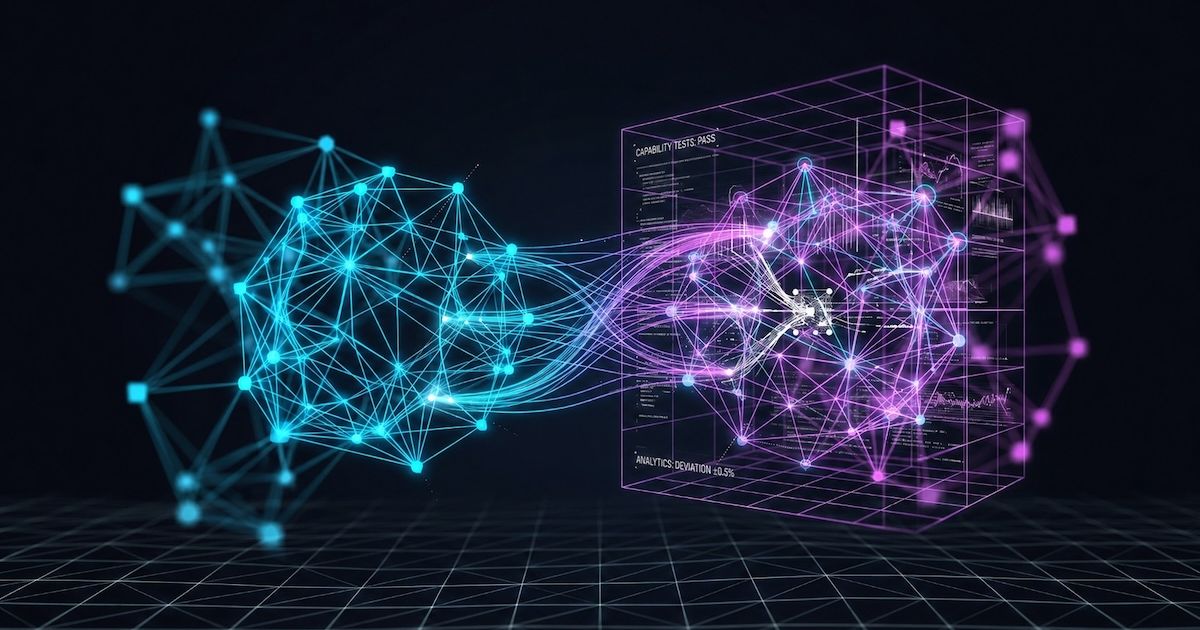
Digital twins are having their moment.
Which usually means two things: every vendor suddenly has one, and most of them are not digital twins.
What we see in the wild are ChatGPT wrappers with a nice UI. We get it. It's easy. Tell Co-Pilot you want a digital twin, hand off your n8n account, and have it spin up Firebase.
The result is a system that writes in a believable voice, everyone nods, and the demo looks good enough for a LinkedIn post.
Fine for some likes and "thought leadership". Not fine for prediction.
At Mnemonic AI, we choose rigor over rhetoric. We set out to answer a much harder, fundamental infrastructure question:
Can a digital twin accurately predict what a specific individual will say when the answer isn't already baked into the prompt? We aren't interested in whether an AI can mimic a generic customer segment or role-play a fictional buyer. We want to know if it can predict a real person’s future responses, measured against a hard scientific benchmark.
Not "can it sound like a customer."
Not "can it roleplay a fictional buyer persona."
That is what we tested our own Digital Twin on.
The problem with pretending
A lot of AI products are good at sounding right. This is not the same as being right.
An LLM can easily generate a convincing response for a generalized demographic, like "a price-sensitive millennial parent who values sustainability." However, that is entirely different from predicting how Sarah from Austin, who answered 200 specific questions three weeks ago, will respond to a brand-new query tomorrow.
The former is mere marketing theater.
The latter is a data science benchmark.
This distinction is critical for marketing, research, and strategy executives. Enterprises are being pitched synthetic customers with promises of faster insights, eliminated panel costs, and instant segmentation. But if these synthetic cohorts cannot be validated against held-out human data, they are simply highly polished opinion engines.
The human ceiling
Here is the annoying part about predicting people: humans are not perfectly consistent. Most of the time, quite the opposite.
If you ask someone the same question weeks apart, their response may shift due to mood, context, or changing preferences. Therefore, aiming for 100% predictive accuracy is a fundamentally flawed metric (And if someone claims 100% accuracy: Run). An AI model shouldn't be expected to predict a person's behavior more consistently than that person predicts their own. Over-optimizing past this point leads to overfitting and flat stereotypes.
The real question isn't whether an AI is flawless, but rather: How close does it get to the limit of human self-consistency? We call this boundary the Human Ceiling.
- In our benchmark testing, humans reproduced their own exact answers 73% of the time.
- When accounting for near-misses, this self-consistency ceiling rises to 83.4%.
- Mnemonic AI (MNAI) achieved an absolute score of 74.2%.
By dividing our score (74.2%) by the human limit (83.4%), we get the metric that actually matters: MNAI captures 89.0% of the predictable human signal.
Methodology and Experimental Design
To ensure true scientific rigor, our benchmark utilized the Twin-2K-500 dataset, a longitudinal study tracking real individuals across multiple survey waves.
We built MNAI’s persona from earlier waves. Demographics, psychometrics, previous answers, the kind of information you would actually have before trying to predict someone.
We completely held out the subsequent survey waves. The target answers were stripped from the prompt, forcing MNAI to generalize without any contextual shortcuts or "peeking." No "the answer was secretly in the context." No vibes-based scoring after the fact. MNAI had to generalize.
Across 2,058 people and 191,406 held-out answers, Mnemonic's Digital Twin predicted how each person would respond. Then we scored those predictions against reality.
Temperature was set to 0, so the benchmark is deterministic. Run it again, you get the same predictions.
Exciting? Maybe not.
Important? Very. Because repeatability is what separates a benchmark from a demo.
How the scoring works
The scoring is not something we invented to make ourselves look good. It follows the dataset’s own metric. An exact match gets full credit. A near-miss gets partial credit. A large miss gets punished.
On a five-point scale, predicting 4 when the real answer is 5 is not the same as predicting 1. Humans behave like this too. They may not repeat the exact same answer, but they often stay close to their earlier position.
This gives us the numbers:
MNAI average accuracy: 74.2%.
Human ceiling: 83.4%.
Normalized result: 89.0%.
That last number is the one that matters, because it tells us how much of the predictable signal Mnemonic captures.
Why True Generalization Beats Wrapper Logic
LLM wrappers are engineered for linguistic plausibility—they generate the most probable next word, not necessarily the correct predictive data point. A true digital twin must survive strict validation against held-out human datasets.
This is where contemporary synthetic research often stumbles. The outputs look beautiful in a slide deck, the segments feel intuitive, and teams move forward on unverified assumptions.
When we segment MNAI's performance by domain, the structural strengths and boundaries of the architecture become highly transparent:
- Reasoning & Judgment: Mnemonic's Digital Twin excels here, reaching 93.8% of the human ceiling.
- Economic & Pricing Choices: These decisions are inherently noisier, with MNAI capturing 84.0% of the human ceiling.
Mapping these failure modes and domain-level variances is exactly how enterprise-grade digital twin infrastructure should be developed.
A wrapper can generate a plausible sentence. That's what it was build for. Give a probable answer NOT the right one.
A true digital twin has to survive contact with held-out data. If your system cannot be evaluated against what real people actually said, you do not know whether it predicts people or merely imitates the language of prediction.
This is where a lot of synthetic research gets shaky. The output sounds polished. The persona feels coherent. The segment names look impressive. Someone puts the answers into a deck. Everyone moves on.
But did the synthetic respondent match the real respondent?
Did it generalize beyond the profile?
Did it stay close to the person’s own future answer?
Most systems do not tell you. Sometimes, because they cannot. Sometimes, the answer would be uncomfortable.
We are not interested in that kind of ambiguity.
The result
MNAI reaches 89.0% of the human ceiling.
The 95% confidence interval is 88.7% to 89.4%.
That is a tight range because the benchmark is not based on a handful of cherry-picked examples. It covers 2,058 real people and 191,406 held-out answers.
We also reproduced the published reference numbers before scoring ourselves. This matters. If you compare against a field benchmark, you need to make sure your code is measuring the same thing the field measured. Otherwise, congratulations, you won a race you quietly redefined.
What this does not mean
This does not mean people are fully predictable.
They are not.
It does not mean every decision can be inferred from a profile.
It cannot.
It does not mean a digital twin replaces research, strategy, or human judgment.
That would be lazy.
Strategic Guardrails: What This Means for Leadership
Deploying digital twins at scale requires a pragmatic understanding of their operational boundaries:
- They do not imply absolute human predictability. Humans remain dynamic and context-dependent.
- They do not replace primary research or strategic judgment. They serve to accelerate and scale it.
What this benchmark does prove is a specific, high-value capability: when deployed correctly, MNAI captures nearly 90% of predictable human signal in a scientifically defensible framework.
The distinction between an LLM wrapper and a validated digital twin isn't just academic. It's an operational necessity for enterprises relying on data infrastructure. Moving past the "demo phase" of AI means demanding measurable, repeatable accuracy. That is the standard we build toward.
Whether it can predict real people in a measurable, repeatable, scientifically defensible way.
That is the difference between a ChatGPT wrapper and a digital twin.
And yes, we think the difference matters.
You can find the full write-up here: Digital Twin Fidelity Test
